

Walking up to a Craps table for the first time can be very intimidating. It seems like looking at a complex blueprint full of symmetrical markings and colorful sections of the table, and rapid commands of the dealer. However, you will find that it is laid out logically to facilitate the player to place bets quickly and accurately once you get the hang of the geometry of the Zelt.
So, knowing what a table consists of is the main thing to gain confidence in the game in case you are playing in a famous hotel or an online platform.
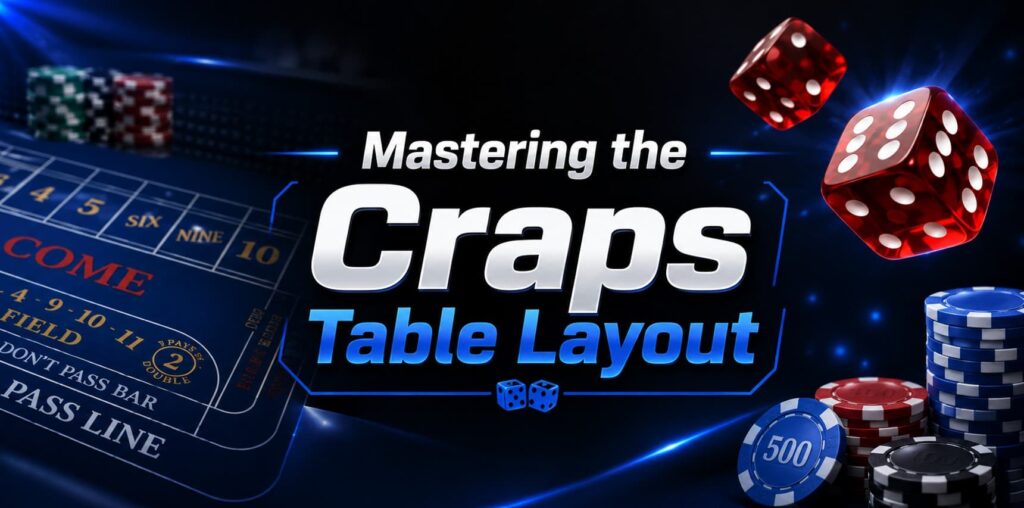
Breakdown of Craps Table Layout
A typical Craps table has three major parts: two mirror-like side areas and a central area. The side areas are there so that players at the two ends of the long table can make their main bets without having to stretch across the whole table. Understand the best carps strategies for beginners from here.
| Section | Purpose | Key Bets Found Here |
|---|---|---|
| The Ends (Side Pits) | Primary betting areas for most players | Pass Line, Don’t Pass, Come, Field, Big 6/8 |
| The Center | High-risk, high-reward “Proposition” bets | Hardways, Any Craps, Yo-Eleven, Horn Bets |
| The Box | The area is managed by Boxman | Point Numbers (4, 5, 6, 8, 9, 10) |
Navigating the Outer Rim: The Fundamental Bets
Standing at the table, the spots nearest to you are the “main action” areas. Here is where the basic bets get laid in the game.
1. The Pass Line and Don’t Pass Bar
The long, curved outline bordering the table layout is called the Pass Line. This is where most players “bet with the shooter”. Inside that is the Don’t Pass Bar, the place where you bet against the shooter (also referred to as “playing the dark side”).
2. The Come and Don’t Come Areas
Placed right above the Pass Line, the Come section acts as a second Pass Line for bets that are made after a point is set. It is a big, wide area that is very accessible.
3. The Field: The One-Roll Gamble
The Field is a big rectangle with numbers 2, 3, 4, 9, 10, 11, and 12 inside. This is a “one-roll” bet. If any of these numbers come out on the next throw, you win. Also, keep in mind that 2 and 12 typically pay double (2x) or triple (3x), and this is most often very prominently indicated on the felt.
The “Point” Zone: The Upper Grid of Craps Table
The uppermost row of the side sections features the digits 4, 5, 6, 8, 9, and 10. Here is the layout where the “Point” is kept track of.
- Place Bets: It is acceptable to instruct the dealer to set your chips on these numbers.
- The Puck: After a point is determined, the dealer puts a plastic piece (“Puck”) with the “ON” side facing everyone on that number. It informs the players that the shooter intends to hit the number before making a roll of seven.
High-Stakes Heart: Center Proposition Bets
The center of the table is a chart of various dice rolls that are strictly controlled by the Stickman. These are “Proposition Bets” (or “Prop Bets”). Besides being very appealing with the potential payout going up to as high as 30:1, they are also the bets with the highest advantage for the house.
- Hardways: wagering that a specific number (4, 6, 8, or 10) will be rolled as a pair (two 4s, for instance, would be a Hard 8) before a “soft” total or a 7.
- Any Craps: A one-roll bet that the next toss will be 2, 3, or 12.
- The Horn: A split bet covering the 2, 3, 11, and 12.
Table Staff: Who Are They?
Recognizing a layout can also involve figuring out where the staff sit since their locations control the movement of the game.
- The Boxman: The one who is located in the middle, facing the Stickman. They oversee the game, secure the “bank” (chips), and settle the conflicts.
- The Dealers (2): One dealer is located at each side section. They are responsible for all payouts and placing bets for the players on their half of the table.
- The Stickman: Positioned in the center of the player side. They have the dice, announce the results, and administer the main prop bets.
Tips to Understand the Craps Table Layout
If you want to get the most of your time at the table, bet in areas with the lowest house edge.
- Keep on the edges: Pass Line and Come bets are really attractive since they have only 1.41% house edge.
- Make the most of “Odds” Bets: When a point is established, you are allowed to put “Free Odds” behind your Pass Line bet. This is a bet with no house advantage at all. There is no dedicated box for this, you just place your chips behind the original bet.
- Stay out of the middle for long gaming sessions: Although the center “Yo-Eleven” or “Hardways” are amusing, they are “sucker bets” if you play a lot since the house advantage is quite high there.
1. What is the most important part of the layout for a new player?
The Pass Line. It is the foundation of the game and offers one of the lowest house advantages (1.41%) in the entire casino.
2. Where should I put my chips when I’m not betting?
Every table has a wooden rail with grooves. You should keep your chips in these “racks” directly in front of you. Never leave them on the felt unless they are an active bet.
3. Do all tables look the same?
The core layout (covering Pass Line, Come, Field, and the numbers 4 through 10) is universal. However, some modern tables may have small “side bet” boxes (like “All-Small-All-Tall”), which may vary by casino.
4. Where should you place your chips in craps?
You place chips in the specific betting box, and dealers organize them based on your position at the table.